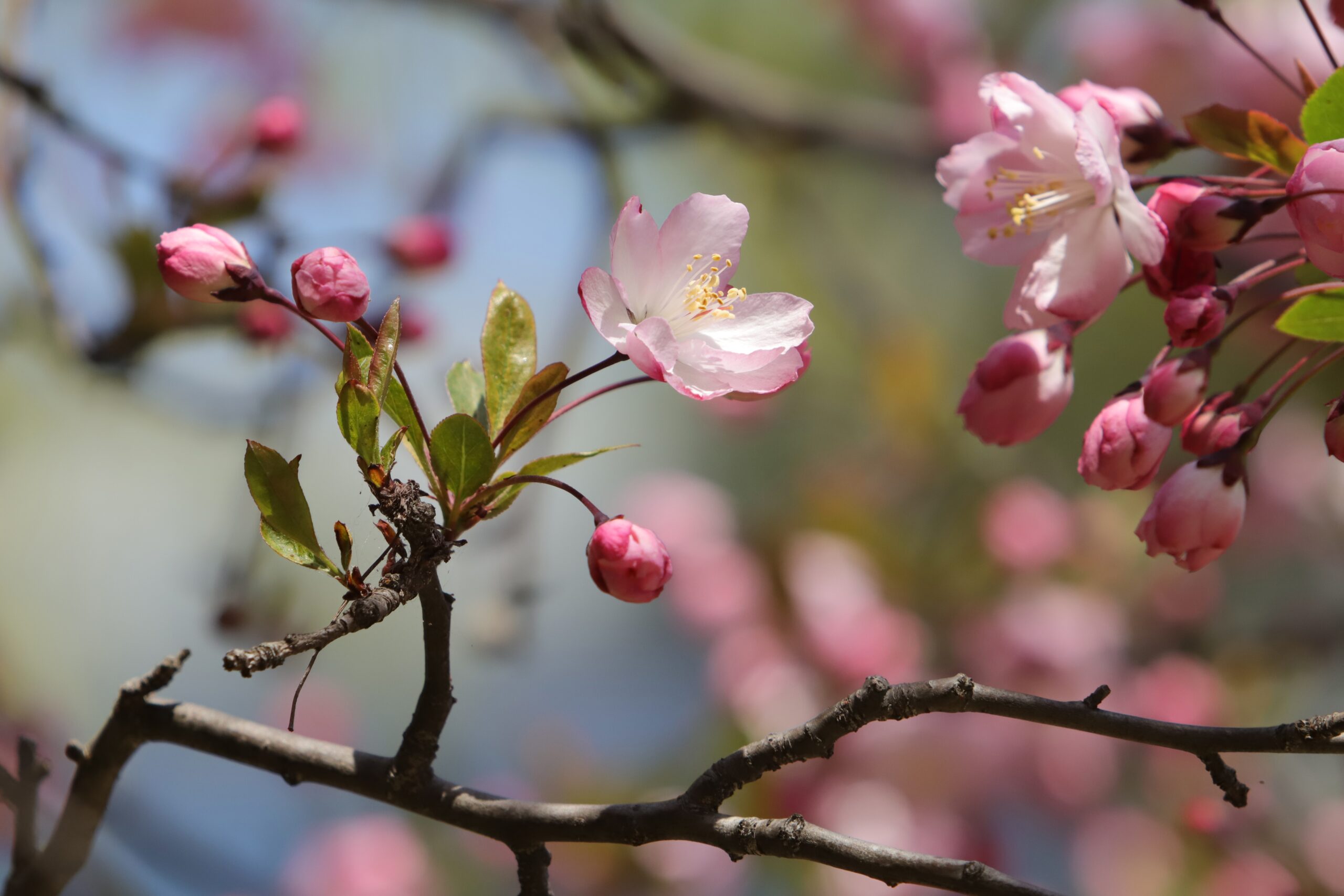
Japanese has a word for the moment cherry blossoms fall in such quantity that it looks like snow.
Hanafubuki. Flower blizzard.
I think about this a lot. Somebody, at some point, decided that this specific event happened often enough and mattered enough that it needed its own noun. Not a description. Not a metaphor you assemble each time. A word, ready to go, that everyone already knows.
A language builds words for what its speakers pay attention to. So the vocabulary around cherry blossoms is basically a record of a thousand years of people looking very carefully at the same trees. Here’s some of it, and why I think it’s worth knowing even if you never learn another word of Japanese.
Sakura zensen — the cherry blossom front
Zensen is a weather term. It means a front, the same way you’d talk about a cold front moving in. The sakura zensen is the line of first blooming as it travels up the Japanese archipelago, starting in subtropical Okinawa in January and reaching Hokkaido in May.
It’s forecast. Seriously forecast, by meteorological agencies, on the news, with maps and dates and revisions. A country tracks the arrival of a flower with the same apparatus it uses for storms.
What I love about this is the scale it puts you on. Your afternoon under one tree is a tiny local instance of something enormous moving slowly across a country. You’re not just having a picnic. You’re standing in the path of a front.
Mankai, and the numbered stages before it
Bloom is measured in stages. Kaika is the opening, officially declared when a designated benchmark tree in a given city has a handful of open flowers. Then it progresses through fractions — thirty percent, fifty percent — until mankai, full bloom, usually about a week after opening.
There’s something quietly funny and quietly moving about the bureaucratic precision of this. Somewhere there is a specific tree, and someone whose job includes going to look at it.
Yozakura — night blossoms
Blossoms after dark, usually lit from below by lanterns or floodlights. The same tree you saw at noon becomes something else entirely: the pink goes pale and strange against a black sky, and the whole canopy seems to float.
Worth its own word because it is genuinely its own experience.
Hanafubuki — the flower blizzard
Peak petal fall, when the wind gets into a tree at the right moment and the air fills.
Most people who’ve experienced it describe the same two things: the silence of it, and how hard it is to photograph. It’s one of those events that a camera flattens into nothing. You get a picture of a tree with some specks.
This is the word I’d most like to give to English.
Hazakura — leaf cherry
The stage after. Petals gone, green leaves coming in, the tree perfectly healthy and completely unremarkable.
Having a word for this feels like the most revealing one in the whole list. It says: we noticed the after, too. We didn’t just stop paying attention when the pretty part ended. Hazakura has a slight melancholy to it, but also a kind of steadiness. The show’s over, the tree is fine, come back next year.
Mono no aware — the feeling underneath all of it
This one is harder and doesn’t translate cleanly. Roughly: a gentle, aching awareness of the impermanence of things, and the beauty that comes specifically from that impermanence.
Not grief. Not nostalgia exactly. Closer to the feeling of a really good last day of a holiday, where the ending is part of what makes it good.
The eighteenth-century scholar Motoori Norinaga made this idea central to his reading of classical Japanese literature, arguing it was the emotional heart of works like The Tale of Genji. But you don’t need the theory. You’ve felt it. Everyone has. Japanese just got there first with a name.
Cherry blossoms became the emblem of it because they’re so unignorably temporary. A flower that lasted two months would mean something completely different.
Why this matters for us
Here’s my actual point, and it’s the reason I’m writing this on a community blog rather than keeping it as a vocabulary list.
Having the word changes the experience. Once you know hanafubuki, you start watching for it. Once you know hazakura, you go back in May to see the leaves. The language hands you a set of things to notice, and noticing them is most of what hanami is.
Classical poets built enormous amounts of work out of these ideas — Saigyō famously wished to die beneath the blossoms in spring, and the anthologies are thick with cherry poems — but the tradition was never limited to poets. It’s ordinary, daily, available to anyone standing under a tree.
So: what are the words where you’re from?
I’m serious about this question. Most cultures have some version of this vocabulary for their own seasonal turns. The particular quality of light in a certain month. The name for the first warm day. The word for a specific wind. Portuguese has saudade, Welsh has hiraeth, and I’d bet your language has three or four things that don’t survive translation either.
Tell us in the comments. Give us the word, roughly what it means, and when you’d use it. I want to build a list. Between all of us we should be able to put together a pretty good vocabulary for paying attention.
That, honestly, might be the most useful thing this blog could produce.